ΑΝΑΛΥΣΕΙΣ
A Eurasian Pact Takes Shape Amid the Ruins of the Old Order
Geopolitical Monitor, Opinion - May 28, 2026, By Kurniawan Arif Maspul
History rarely announces the birth of a new geopolitical era with a single treaty or military parade.
More often, it emerges quietly through pipelines buried beneath frozen soil, through satellite constellations drifting above contested skies, through currency settlements that no longer pass through New York or London. The deepening convergence between China and Russia is beginning to resemble precisely such a moment — not yet a formal alliance, but something potentially more consequential: the gradual construction of a Eurasian strategic sphere designed to outlast American primacy.
What makes this shift especially unsettling is not the theatrical rhetoric of a ‘multipolar world’, but the sober strategic logic driving it. Moscow and Beijing no longer merely cooperate because they share grievances against Washington. They increasingly cooperate because both leaderships now perceive the liberal international order as structurally incapable of accommodating their ambitions. One seeks restoration; the other seeks ascendance. Together, they are testing whether global power can be reorganized around continental resilience rather than maritime dominance.
Energy Corridors and the New Geography of Power
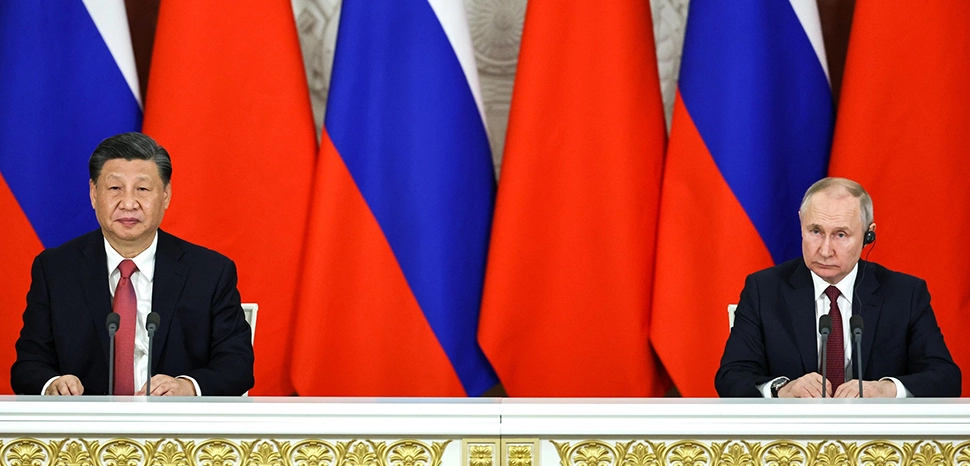
The symbolism of recent Xi Jinping–Vladimir Putin summits masks the harder reality beneath. Russia’s war in Ukraine and the subsequent avalanche of Western sanctions accelerated a geopolitical transformation already underway. By 2025, Russian pipeline gas exports to Europe had collapsed by 44 per cent compared with pre-war levels. Europe — once the crown jewel of Moscow’s energy strategy — is being replaced by Asia. The center of gravity of Russian state survival is shifting eastward with historic speed.
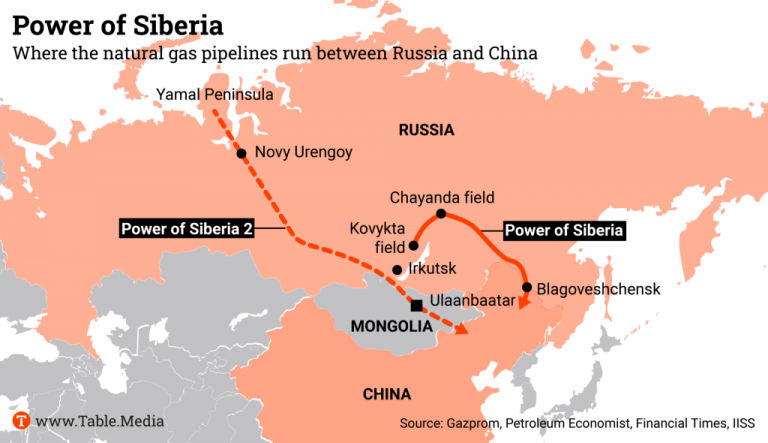
The proposed Power of Siberia II pipeline embodies this transformation more than any diplomatic communiqué ever could. Stretching roughly 2,600 kilometers through Mongolia, the project would channel up to 50 billion cubic meters of gas annually from Russia’s Yamal fields into northern China. CSIS analysis suggests Russia could eventually export more than 100 bcm annually to China by 2030. Such figures are not merely commercial statistics; they represent the remapping of Eurasia itself.
For Beijing, the pipeline is about much more than energy. Chinese strategic planners have long feared the ‘Malacca dilemma’ — the vulnerability of maritime trade routes passing through chokepoints potentially controlled by the United States Navy. Land-based energy corridors from Russia reduce exposure to naval interdiction. In Beijing’s strategic imagination, every kilometer of steel pipe across Siberia weakens the coercive leverage of sea power.
Sino-Russia Relations: A Partnership Built on Asymmetry
Yet this partnership is not one of equals. That is the paradox haunting the relationship. Russia increasingly resembles the junior stakeholder in a Eurasian order it once imagined leading. Beijing understands this perfectly. China’s economy is nearly ten times larger than Russia’s. Chinese trade with the European Union and the United States still dwarfs commerce with Moscow. While the Kremlin urgently requires Chinese finance, semiconductors, industrial inputs and export markets, Beijing retains options. Chinese negotiators reportedly pushed for domestic Russian pricing during pipeline discussions — a humiliation unimaginable during the Soviet era.
The emotional undercurrent inside Moscow is impossible to ignore. A civilization that once challenged Washington for global supremacy is now slowly accepting dependence on Beijing. Beneath the ceremonial declarations of ‘no limits‘ friendship lies a harsher reality: Russia needs China far more than China needs Russia. And yet dependence does not diminish the strategic danger of their convergence. It may actually intensify it.
What is emerging is not a traditional Cold War bloc but a flexible anti-hegemonic ecosystem. The partnership thrives precisely because it avoids the rigid obligations of NATO-style alliances. Chinese officials continue insisting there will be no formal military pact. Russian Defence Minister Sergei Shoigu similarly declared the relationship is ‘not creating a military bloc’. That ambiguity is deliberate. Formal alliances create liabilities; strategic ambiguity creates room for maneuver.
Instead, Beijing and Moscow are constructing parallel structures beneath the existing order. Trade increasingly settles in yuan and rubles rather than dollars. BRICS expansion is being weaponized as a diplomatic instrument against Western financial dominance. The Shanghai Cooperation Organization is evolving from a regional security forum into a broader political platform for post-Western coordination.
The Rise of a Dual‑Use Eurasian Tech Sphere
What once appeared symbolic now carries institutional weight. The technological dimension may prove even more consequential than pipelines or banking systems. US policymakers often interpret Sino-Russian cooperation primarily through the lens of Ukraine or Taiwan. That view risks missing the larger strategic revolution underway: the gradual fusion of complementary technological capabilities designed to erode Western advantages across multiple domains simultaneously.
China brings manufacturing scale, artificial intelligence ecosystems, advanced telecommunications infrastructure and satellite production capacity. Russia contributes decades of expertise in missile engineering, nuclear propulsion, electronic warfare and strategic weapons systems. Together, they are constructing what some analysts increasingly describe as a dual-use Eurasian technology architecture.
The reaction to Washington’s proposed ‘Golden Dome’ missile defense initiative revealed this emerging alignment with unusual clarity. Both Beijing and Moscow condemned the project as destabilizing and contrary to strategic balance. CSIS assessments note that neither country intends to mirror American missile defense architecture symmetrically. Instead, both favor asymmetric countermeasures designed to render such systems ineffective.
That strategy is already visible. Russia continues investing heavily in hypersonic weapons such as Avangard, Poseidon, and Burevestnik. China has rapidly expanded hypersonic glide vehicle testing while building sophisticated anti-satellite capabilities. Combined with growing collaboration in AI-enabled military systems and space infrastructure, the result is a layered challenge to traditional American deterrence models.
The significance extends far beyond military competition. Control over technological standards increasingly determines geopolitical influence itself. Huawei’s role in Russian AI ecosystems, joint aerospace projects, coordinated research initiatives and shared satellite ambitions point toward the emergence of an alternative innovation sphere no longer dependent upon Western systems.
The result is not simply military balancing. It is systemic insulation. The old post-Cold War assumption — that economic integration would inevitably socialize rising powers into the liberal order — is quietly collapsing. Instead, the opposite dynamic is unfolding: integration provided the resources through which revisionist powers could eventually challenge the system from within.
The views and opinions expressed in this article are those of the author alone and do not represent those of Geopoliticalmonitor.com

yiota
Author’s Posts
-
Iraq’s Oil Lifeline Reopens — But Can Baghdad Trust Turkey for Even One Year?
Aoû 11, 2026
-
Central Asia and Azerbaijan Extend Cooperation Across the Caspian
The Central Asia Times, 11 Augu...
Aoû 11, 2026
-
Ποιοι Είμαστε
της Παναγιώτας Παπαρούνα
Ο μεγάλος ευρασιατικός μας κόσμος!
Της Παναγιώτας Παπαρούνα
Ιράν: Ο Μοτζτάμπα Χαμενεΐ προχώρησε σε αλλαγές κορυφής – Ετοιμάζεται για παρατεταμένη σύγκρουση